Signal-Based Selling in 2026: The 7-Step Framework to Replace Cold Outbound with Triggered Plays

Signal-based selling is pretty simple in concept: instead of blasting outbound from a static list, you wait for something real to happen at a target account, and then you reach out. A job posting goes up. A funding round closes. Someone hits your pricing page three times in a week. That’s your trigger.
The Ehrenberg-Bass Institute and the LinkedIn B2B Institute have been saying for years that only about 5% of B2B buyers are in-market at any given time. We all nod along when we hear that number and then go back to spraying the other 95% with cold sequences anyway. Reply rates tell the story: 1 to 4%, industry wide.
Here’s what’s weird though. Most teams already know this. They’ve bought intent tools. They have UserGems or Common Room or 6sense running. And they’re still missing quota.
In my experience the signals are rarely the problem. It’s everything that happens after detection. The signal fires, it lands in a queue somewhere, and nobody acts on it fast enough (or at all). That’s what this framework is about.
We’re going to walk through seven steps. Each one names specific tools, gives you an SLA to hold yourself to, and flags the failure mode we see teams hit most often. When teams actually run this, the numbers look like:
- 15 to 25% reply rates on signal-triggered outbound vs 3 to 4% on cold (Apollo’s 2026 benchmark)
- 30 to 40% shorter sales cycles on signal-led deals, per Apollo’s study of 94 B2B companies
- Pipeline that doesn’t collapse the moment you lose an SDR
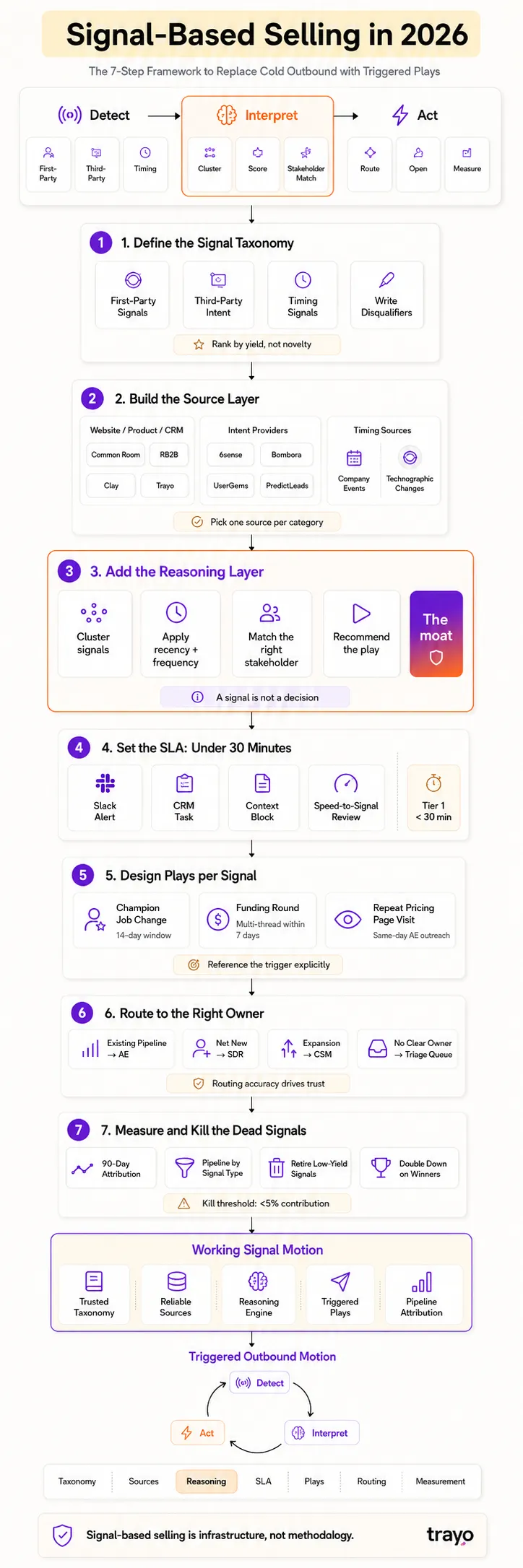
Step 1: Define the signal taxonomy your team will actually trust
Before you buy anything, write the taxonomy. I can not stress this enough. The biggest cause of signal fatigue isn’t that teams have too many signals. Its that nobody agrees on what “buying signal” actually means. Marketing thinks it’s a Bombora surge. Sales thinks it’s a pricing page visit. RevOps thinks it’s a lead score. Three teams, three definitions, one CRM full of noise.
Three categories, no more
Keep it flat. Every team I’ve seen try to launch with 10+ signal types ends up cutting back to three within a quarter. Save yourself the pain.
- First-party signals: Stuff happening in your own systems. Pricing page visits, demo requests, product signups, free trial activity, repeat visits from a known contact.
- Third-party intent signals: Research happening off your site. Bombora surges, G2 Buyer Intent, review reads, competitor comparison traffic.
- Timing signals: External events that open a window. Funding rounds, exec hires, layoffs, M&A, earnings call mentions, tech stack changes.
Rank by yield, not novelty
Teams consistently over-weight third-party intent because it feels sophisticated. But the actual conversion data doesn’t back that up.
- Highest yield: Repeat pricing page visits from a named contact at a target account. Apollo and Gong both put these in the 15 to 20% range for converting to first meeting.
- High yield: Champion job change at a former customer. UserGems reports 3x average close rate on these.
- Medium yield: Funding round at an ICP account. PredictLeads and Coldreach see 2 to 3x cold baseline conversion to meeting.
- Variable yield: Third-party intent surges. Fine as a tiebreaker, not great as your only trigger.
Why this matters: Getting the ranking right is the difference between a play your reps actually run every day and a queue they learn to ignore by week two.
Write the disqualifiers
Every signal type needs an off switch. A Series A at a 12-person startup is a completely different signal than a Series C at a 400-person company. Build the disqualifier into the signal definition itself. Don’t leave it up to the rep to figure out which ones matter.
Step 2: Build the source layer
You can’t act on what you can’t see. The source layer is just the set of tools that detect events. And honestly this is where most teams spend way too much money relative to what they get back.
First-party detection
You probably already own most of this. The gaps are usually config issues, not missing tools.
- Website behavior: Common Room, RB2B, or whatever reverse-IP stack you’re already running. Make sure you’re tracking pricing page, demo request, and high-intent doc pages specifically.
- Product usage: Pipe signups, repeat sessions, and feature activation from your warehouse into Salesforce or HubSpot via Census or Hightouch.
- CRM events: Renewal dates coming up, opps that went closed-lost more than six months ago, contact role changes. This stuff is free and almost nobody uses it well.
Third-party intent
Pick one provider. I mean it. Stacking Bombora and G2 Buyer Intent and 6sense together creates more noise than signal, every time.
- Mid-market and enterprise: 6sense, Demandbase, or Trayo. The first two were named leaders in the Forrester Q1 2025 Wave for B2B intent data, 6sense reports processing over 1 trillion signals daily. Trayo is the AI-native entrant and yes, we’re biased, but we built the product specifically for this layer (see how Trayo compares to 6sense).
- SMB or product-led teams: Common Room for community and engagement signals across Slack, Discord, GitHub, LinkedIn.
- Category-specific: G2 Buyer Intent if your buyers actually shortlist on G2.
Timing signals
This is where most teams under-invest, which is frustrating because it’s where the highest-yield signals actually live.
- Job changes and exec hires: UserGems for champion tracking, Trayo for reasoned signals, Clay workflows if you want to build it yourself.
- Funding and corporate events: PredictLeads, Crunchbase Pro, or Trayo for an aggregated feed.
- Tech stack changes: BuiltWith or HG Insights for confirmed adds and drops.
Implementation checklist:
- One source per category. Not three.
- Everything pipes into one place. If you’re orchestrating in spreadsheets, look at Clay. If you’re building production signal infrastructure, use something purpose-built like Trayo or a warehouse-first stack with reverse ETL.
- If a tool can’t get signals into your warehouse or CRM within 24 hours of detection, pass on it.
Step 3: Add the reasoning layer (this is where most teams fail)
Ok, here’s where it gets real. A signal by itself is just a data point. The teams who are actually winning right now invest heavily in the layer between detection and action: the system that decides what a signal means and what you should actually do about it.
Most signal vendors don’t build this part. They give you the feed and leave interpretation to the rep. The rep, predictably, ignores half of it.
Cluster signals before you act
Single-signal alerts are basically noise. There’s a growing RevOps consensus around what people are calling the cluster-of-three rule: don’t route anything to a human unless you have 2 to 3 distinct signals within a 7-day window.
- Worth routing: Funding round + new VP of Engineering hire + pricing page visit from a director at the same company. That’s a cluster.
- Not worth routing: A standalone Bombora surge with zero first-party activity. That’s a maybe at best.
Apollo, Clay, and Common Room have all reported that clustering cuts false positives by more then half vs. single-signal triggers.
Score by recency, frequency, and stakeholder
The model we like: signal score = base score x time decay x frequency. Base score reflects the inherent strength of the signal. Time decay penalizes anything older than 14 days. Frequency rewards repeated engagement.
Stakeholder matters too, obviously. A pricing page visit from a VP is a fundamentally different event than one from an intern. Enrichment tools like Clearbit (now part of HubSpot), Apollo, or Findymail close that gap.
Decide the play, not just the priority
The reasoning layer should not just spit out a priority score. It should recommend a play. For every account it should tell the rep: what signal triggered this, who’s the right person to open with, and what message connects the signal to your value prop.
This is the part almost everyone skips. They route a number to the rep and hope for the best. It doesn’t work.
This is exactly the gap we built Trayo for. Our reasoning engine takes raw signals from whatever sources you’re already running, clusters them by account, scores by stakeholder match and recency, and outputs a play recommendation the AE can act on without doing 20 minutes of research first. Most of the market still leaves that work to the rep.
Why this matters: Signal acquisition is table stakes at this point. The reasoning layer is what actually differentiates. If your stack stops at detection, you’ve bought intent data. You have not built signal-based selling.
Step 4: Set the SLA at speed-to-signal under 30 minutes
A signal that sits for 48 hours is dead. Both Apollo and Pavilion put the top-performer bar at under 30 minutes from detection to first action in their 2026 benchmarks. The median team? 19 hours. That’s not a typo.
This is an ops problem, not a tools problem.
Build the alert path
Get the signal to the rep where they already are.
- Slack first: DM or channel ping. Fastest path by far. Pipe through your CRM workflow, Zapier, or a reverse-ETL job.
- CRM task second: But make sure the signal context is attached. A generic “follow up” task helps nobody.
- Email last: Only for low-priority signals that don’t need same-day action.
Pre-stage the context
Your rep should not have to go research the signal before they can act on it. Attach the signal type, the stakeholder, two or three firmographic facts, and a draft opener.
Outreach and Salesloft both support signal-triggered cadence enrollment with variable injection, use it. At Trayo we pre-assemble the whole context block before the alert reaches the rep so what they get in Slack or email is a play they can run, not a research assignment.
Hold the SLA accountable
Speed-to-signal is a real metric. Track it. Review it in the weekly pipeline meeting. Teams that actually hold themselves to the SLA produce 2 to 3x the pipeline per signal vs teams that treat it as a nice-to-have.
Implementation checklist:
- SLA per tier: Tier 1 under 30 min, Tier 2 under 4 hours, Tier 3 same day.
- Slack alerts with full context. Not a link, the actual context.
- Review SLA adherence weekly. Make it visible.
Step 5: Design plays per signal, not per persona
Persona-based cadences were fine in 2018. In 2026 the play should be specific to the signal that fired, not the job title of the person you’re emailing.
One play per signal type
Map every signal category to a specific motion. Some examples:
- Champion job change: Three touches within 14 days. Day 1 LinkedIn note, Day 4 email with a quick congrats and a soft check-in, Day 9 a Vidyard or Sendspark video referencing the past relationship.
- Funding round: Multi-thread the account within 7 days. Hit the new VP of Sales, the CFO, and one IC. Open with a specific mention of the round plus a use case from a similar company.
- Repeat pricing page visit: Same-day outreach from the AE, not the SDR. Reference the specific page. Offer a 15-minute walkthrough, not a “discovery call.”
Reference the signal explicitly
Fastest way to kill signal-based outreach: write a generic email and pretend it’s personalized. If you can’t name the trigger in the opener, the play is wrong.
Test and retire
Every play has a shelf life. Track reply rate and meeting conversion per signal type. Anything under 8% reply rate after 30 days gets killed.
Plays we recommend starting with:
- Champion tracking: Highest-yield play by far. 14-day window from detection. UserGems data shows buyers are 62% more open to outreach during this window.
- New exec at target account: 7-day window, multi-thread. New execs are 10x more likely to bring in new vendors in their first 90 days.
- Product activation by unknown user: Same-day, AE-led, casual opener.
- Competitor displacement: Fires when a target account’s customer publicly complains about a competitor or drops them from their stack (BuiltWith or HG Insights detection).
Step 6: Route signals to the right rep with the right context
Routing is the quiet killer. A signal that lands on the wrong rep is actually worse than one that doesn’t get routed at all, because it erodes trust in the whole system.
Match signal to owner
Every signal has a natural home. Build the routing logic into the workflow.
- Existing pipeline account: Goes to the AE on the deal.
- Closed-lost within 12 months: Goes to the AE who lost it.
- Net new account: Goes to the SDR who owns the territory.
- Customer expansion signal: Goes to the CSM, not sales.
Use enrichment to disambiguate
Routing breaks when the account is ambiguous. Duplicate domains, parent/subsidiary confusion, overlapping territories. Run every signal through enrichment before routing. Clay and Apollo both handle this well.
Build the fallback
Not every signal has a clear owner. Those need a triage queue, not a round-robin default assignment. For Tier 1 signals especially, a human triage step produces way better outcomes than auto-routing.
Why this matters: A misrouted signal isn’t neutral. It teaches your reps that the system doesn’t work, and they stop checking it. Routing accuracy is probably your best leading indicator of whether the whole program is healthy.
Step 7: Measure pipeline per signal type and kill the dead ones
This is the step most teams never actually get to. They measure activity, signals routed, plays sent, emails opened. They don’t measure pipeline created per signal type.
You have to flip that.
Track pipeline attribution per signal type
For every signal that fires, track what happens downstream over 90 days. Pipeline created, meetings booked, opps advanced, closed-won.
- Tools that do this natively: Gong and Outreach both report signal-attributed pipeline if you configure them.
- DIY version: Weekly Salesforce export joined to your signal log in a warehouse view. Works fine honestly.
Kill the dead signals
You’ll probably find that 30 to 50% of your active signal types produce zero measurable pipeline. Cut them. I know the instinct is to keep them “just in case” but every dead signal type in the queue makes your reps trust the system less.
Reinvest in what works
Your top 3 to 5 signal types will generate most of your pipeline. Put more volume behind those. Build deeper plays for them. Tighten the SLAs. The compounding return on a signal that’s actually working is significant.
Implementation checklist:
- 90-day pipeline attribution review, quarterly.
- Kill threshold: any signal type contributing less than 5% of pipeline after two quarters gets retired.
- Reinvest the eng and play-design time into your top performers.
Wrapping up
Signal-based selling in 2026 is infrastructure, not methodology.
The teams that are actually winning built every layer:
- Taxonomy that defines what counts and what doesn’t
- Source layer that detects events the team can trust
- Reasoning layer that turns raw signals into specific recommendations
- SLA that keeps the whole thing fast enough to matter
- Play library that ties each signal to a real motion
- Routing that puts signals in the right hands
- Measurement that kills what isn’t working and doubles down on what is
For most teams, the bottleneck isn’t signal volume. It’s the reasoning layer between detection and action. That’s the layer we’re building at Trayo.
We detect signals across first-party, third-party, and timing sources. We interpret them through a reasoning engine that clusters, scores, and decides which plays to run. And we route the play to your AEs and SDRs inside the tools they’re already in. If you’re scoping out a signal-based motion for this year, reach out and we can walk through what the infrastructure looks like for your team.
See the buying signals for your accounts
Drop in your work email and Trayo returns 8 real buying signals for your company — free, in about 30 seconds. No call, no credit card.